
Cold Forming Services
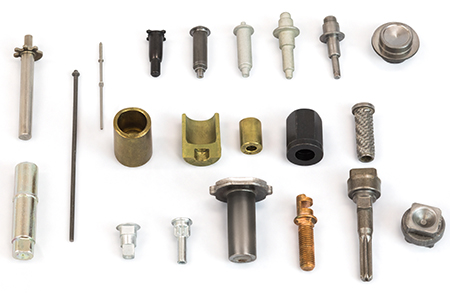
Spartan Fastener produces standard and custom cold-formed parts for many applications, from automotive and electronics to medical. We offer over 2,300 products, including a variety of specialty pins, terminals, rivets, and other proprietary value-added parts. With over 40 years of experience in manufacturing cold-headed components, we provide custom solutions for all types of fastening needs. We stock materials including carbon and alloy steel, copper, brass, and common grades of stainless steel.
Our facility is equipped with a range of cold forming machines, from 1 die 2 blow machines to 6 die 6 blow progressive headers, which is rare in the industry. These multiple-station cold formers enable us to produce intricate cold-formed components through a series of upset and extrusion stations. Metal blanks with cutoff sizes up to 1" and lengths up to 6" can be processed with minimum or no material scrap.
Spartan Fastener's cold metal forming operations offer significant advantages such as design versatility, high production rates, repeatability, and increased strength of components. In addition to multi-station cold heading, we offer secondary services such as plating, painting, and heat treating. To support our customers' cost-saving efforts and improve manufacturability, our staff provides expertise and suggestions for appropriate materials, tolerances, and part configurations.
Materials Commonly Processed
Various alloys listed below:
|
|
Secondary Operations
Spartan Fastener has multiple partners who provide us with their expertise in their special services, such as heat treating and plating. Many other value-added operations are also available, but NOT limited to:
-
Trimming
Trimming is a secondary precision operation used to remove excess material (known as flash) or to reshape the head or body of a cold-formed part into specific geometric profiles, such as a hexagon or square. During the initial cold-heading process, metal is upset and compressed into a die, which naturally leaves rounded heads or residual material. By integrating a dedicated trimming step, Spartan Fastener takes these raw, cold-formed blanks and shears away the excess perimeter—establishing the sharp corners, precise dimensions, and finished profiles required for complex industrial applications that cannot be achieved by multi-station dies alone. -
Trimming (Primary Capability)
Trimming as a primary capability is a high-speed, inline shearing action performed directly inside multi-station progressive cold-formers to cut away excess metal or reshape a part’s head geometry. When standard upsetting creates a round head, an inline trimming station can immediately punch a clean hexagon, square, or custom flange configuration into the part before it is ejected. This integrated capability allows Spartan Fastener to manufacture complex, multi-sided geometric fasteners entirely on a single machine, dramatically reducing handling costs and lead times. -
Thread Rolling
Thread Rolling is a cold-forming secondary process where hardened steel dies are pressed against a blank component to displace and mold the metal into external screw threads, rather than cutting material away. This process perfectly complements the initial cold-heading phase because it maintains the continuous structural integrity of the part. Because cold-forming already aligns and packs the internal grain flow of the metal, rolling the threads afterward further cold-works the material. This results in significantly higher tensile, shear, and fatigue strength compared to traditional machined or cut threads, delivering a highly durable fastener. -
Thread Rolling (Primary Capability)
Thread Rolling as a primary capability utilizes heavy-duty rolling dies integrated directly into or inline with the cold-forming equipment to cold-forge external threads onto the freshly headed blanks. By displacing the surface metal to form the peaks and valleys of the thread profile, the rolling action prevents the micro-tears and structural stress risers common in cut threads. This automated, high-velocity process maximizes production output while delivering threads with superior grain alignment, high fatigue resistance, and an exceptionally smooth finish. -
SEMS Rolling
SEMS Rolling is a specialized manufacturing process where a loose washer is pre-assembled onto a cold-headed blank immediately before the thread rolling operation takes place. In a cold-forming workflow, a blank is produced with a specific unthreaded shank diameter, allowing a custom washer to be mechanically slipped into place. When the part subsequently passes through the thread rolling dies, the outer diameter of the thread expands, becoming larger than the inner hole of the washer. This permanently traps the washer on the cold-formed fastener, creating a high-efficiency, captive assembly that streamlines end-user production lines. -
Roll Forming
Roll Forming is a precise secondary operation used to create complex shapes, grooves, knurls, or contours along the cylindrical body of a part by pressing it between hardened steel dies. Unlike traditional lathe turning which cuts away material and weakens the component, roll forming displaces the metal without removing any material. When applied to cold-formed blanks, this process capitalizes on the metal's existing, tightly packed grain structure, further cold-working the surface to deliver exceptional dimensional repeatability and enhanced wear resistance on the formed details. -
Shaving/Pointing
Shaving and Pointing are specialized finishing techniques used to achieve ultra-precise tolerances, chamfers, points, or unique end-geometries on a fastener. While high-speed cold heading is excellent for rapidly shaping the main body of a part, certain complex applications require highly specific tip shapes (like dog points or pilot points) or exceptionally flat head surfaces. Shaving mechanically shears away microscopic layers of metal to eliminate minor imperfections, while pointing precisely carves the tip, ensuring the cold-formed component feeds flawlessly into automated assembly equipment. -
Drilling
Drilling is a secondary machining process used to create precise internal holes, cross-holes, or cavities within a cold-headed component. Because cold-forming is primarily an external shaping process that works by displacing solid metal, creating hollow or side-vented features often requires post-forming machining. By drilling directly into a robust cold-formed blank, Spartan Fastener can produce specialized items like hollow rivets, safety-wire fasteners, or custom fluid-passage components while retaining the high-strength base structural integrity generated during the initial cold-heading phase. -
Broaching
Broaching utilizes a specialized, multi-toothed cutting tool to shave away material and generate complex internal or external geometric features, such as keyways, splines, flats, or non-standard internal sockets. When a cold-formed part requires precise internal shapes that cannot be completely formed by a header punch alone, secondary broaching cleanly carves out the exact configuration. This process bridges the gap between the rapid, high-volume efficiency of cold-forming and the tight geometric demands of intricate, high-precision engineering components. -
Heat Treatment
Heat Treatment is a controlled thermal process—such as hardening, tempering, or annealing—used to intentionally alter the physical and mechanical properties of a metal part. The intense pressure of the cold-forming process naturally induces work-hardening, which significantly increases the part's tensile strength but can also increase brittleness. Post-forming heat treatment allows Spartan Fastener to precisely balance hardness and ductility, relieving internal manufacturing stresses and ensuring the final fastener meets strict industrial or automotive load-bearing specifications. -
Plating
Plating is the electrochemical or chemical application of a thin metal layer—such as zinc, nickel, copper, or chrome—onto the surface of a finished component. Cold-formed steel and alloy parts are highly durable but can be vulnerable to environmental oxidation and rust. Applying a professional plating layer directly over the cold-worked surface provides a robust barrier against corrosion, improves aesthetic appearance, manages electrical conductivity, and modifies the surface friction coefficient for more consistent torque during final installation. -
Painting
Painting (or industrial coating) involves applying a protective liquid layer or powder coating to the exterior of a manufactured fastener. Following the cold-forming and secondary finishing stages, painting is primarily utilized to match the visual requirements of the end product (such as automotive body panels or consumer appliances) while adding an extra layer of environmental protection. This specialized coating shields the high-strength cold-formed metal beneath from moisture, chemicals, and UV exposure, extending the operational lifespan of the assembly. -
Thread Patch
A Thread Patch is a secondary application where a localized layer of nylon, polymer, or engineered plastic is permanently fused onto a specific section of a fastener's threads. During high-vibration applications, standard cold-formed screws and bolts can back out or loosen over time. The addition of a thread patch creates prevailing torque—a deliberate interference fit—that prevents the fastener from vibrating loose while allowing it to be adjusted or reused, providing a cost-effective alternative to loose locking washers or chemical liquid threadlockers on the assembly line. -
Adhesive
Adhesive coating involves applying a micro-encapsulated liquid threadlocker or sealant to the threads of a cold-headed fastener prior to shipping. When the end-user installs the component, the mechanical friction of threading it into place ruptures the microscopic capsules, activating the chemical adhesive to form a powerful, permanent bond and environmental seal. This secondary treatment transforms a standard cold-formed fastener into a high-security locking solution that simultaneously seals against fluid leaks and completely prevents vibration-induced loosening. -
Lubricants
Lubricants are specialized torque-modifying coatings applied to the surface of finished fasteners to control and stabilize the friction generated during installation. Because cold-forming produces incredibly smooth, uniform surface finishes, the friction coefficient can vary depending on the base material. Applying a secondary dry-film or wax lubricant ensures highly consistent torque-tension relationships, preventing issues like thread galling in stainless steel and allowing automated assembly systems to drive the cold-formed parts tightly and accurately without damaging the mating components. -
Over-Molding
Over-Molding is a multi-material manufacturing process where a pre-formed metal component is inserted into an injection molding machine, and a plastic or elastomeric polymer is molded directly around a section of it. Cold-forming is the ideal method for creating the strong, precise metal "insert" or core due to its exceptional structural integrity. The subsequent over-molding step adds lightweight plastic handles, insulated housings, or integrated rubber seals directly to the cold-worked metal, creating a high-performance hybrid component. -
Blank Rolling Extrusion
Blank Rolling Extrusion is a fundamental cold-forming capability where a solid metal wire or blank is driven forward into a reducing die, forcing the material to extend in length while accurately shrinking its diameter. This high-speed capability is the bedrock of producing multi-diameter pins, stepped shafts, and complex fastener blanks. By forcing the cold metal to flow smoothly into the die restrictions, the process compresses the material's grain boundaries, substantially increasing the shear and tensile strength of the stepped transitions without generating any scrap material. -
Piercing
Piercing is an integrated cold-forming capability where a precision punch is driven completely or partially through a metal blank to create clean holes, recesses, or internal cavities. Unlike drilling, which cuts out a spiral of waste metal, cold piercing displaces the material outward into the surrounding walls of the die. This clean displacement ensures that the internal grain flow of the fastener wraps seamlessly around the hole rather than being severed, maximizing the structural load capacity around the pierced feature while maintaining high-speed production efficiency. -
Pointing
Pointing within the primary cold-forming machine involves using a specialized die or integrated heading tool to shape the lead end of a wire blank as it is being cut and formed. This primary capability establishes a tapered, rounded, or chamfered edge on the tip of the fastener before it ever leaves the heading machine. Creating this clean, angled entry point directly during the high-speed cold-heading process eliminates the need for an expensive secondary machining operation and ensures the final part aligns effortlessly into automated assembly fixtures. -
Sizing
Sizing is an ultra-precise cold-forming capability where a previously headed component is struck or pushed through a highly calibrated sizing die to lock in exact final dimensions and extremely tight tolerances. Because metals exhibit minor "spring-back" after being compressed, sizing serves as a critical calibration step. It compresses the outer boundaries of the cold-worked metal one final time, achieving a level of dimensional accuracy, roundness, and surface finish that rivals traditional precision grinding—all while maintaining the rapid throughput of cold-forming. -
Upsetting
Upsetting is the foundational mechanism of the cold-heading process, where a specific length of wire blank is securely gripped in a die while an intense axial force strikes the exposed end, compressing the metal and causing it to flow outward to increase its diameter. This capability is used to form the heads of screws, the flanges on bolts, and large diameters on specialized pins. By accurately controlling this metal displacement at room temperature, upsetting creates an unbroken, continuous internal grain flow that gives cold-formed components their legendary strength and resistance to structural failure under heavy loads.